You spend money getting your fade lined up perfectly. You’ve got the beard oil, the grooming routine dialled in. But there’s one thing a good barber can’t fix, no matter how sharp the cut: a jawline that looks wider or squarer than you’d like, usually thanks to an overdeveloped masseter, the muscle you’re using right now to clench your jaw.
This is where masseter reduction comes in, and it’s become one of the more requested treatments among men over the last couple of years, for reasons that go beyond looks.
What’s actually happening in your jaw
The masseter is one of the strongest muscles in the body relative to its size. In some men it’s naturally larger, and it often gets bigger over time from teeth grinding (bruxism) or jaw clenching, frequently linked to stress. An overdeveloped masseter can give the lower face a squarer, boxier look and, in a lot of cases, comes with jaw tension, headaches, or a clicking jaw people just live with.
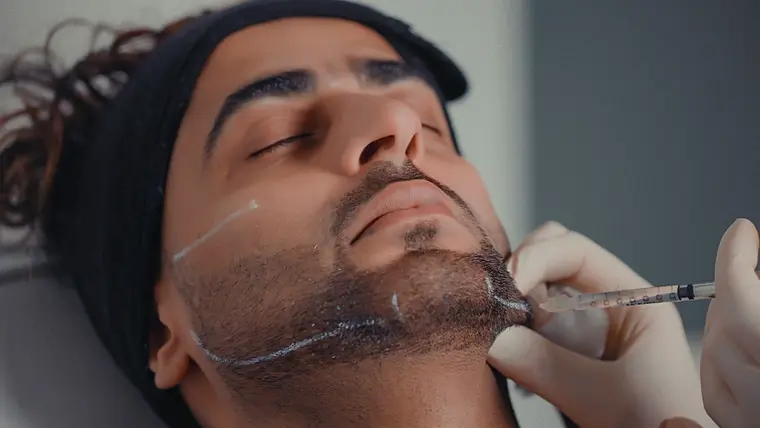
Masseter Botox uses targeted injections into the muscle to relax it. Over the following weeks the muscle gradually reduces in bulk as it’s used less intensely, which can slim and sharpen the jawline.
What to actually expect
“It’s a quick appointment, 15 minutes,” says Dr Hasaneen Al Janabi, the Royal College of Surgeons member who performs masseter reduction in Mayfair, London. “Most men need 20 to 40 units per side, sometimes up to 50 for larger muscles. The change isn’t instant, it builds gradually over six to eight weeks as the muscle relaxes. A lot of our male patients come in for the jaw tension and clenching first, and the slimmer jawline is almost a bonus.”
Results typically last around six months before a top-up is needed, so most men treat it as something to repeat roughly twice a year.
Worth knowing before you book
- It won’t change bone structure. If your jaw width comes from the underlying bone rather than the muscle, this won’t be the fix
- It can genuinely help with clenching, grinding and related jaw tension, not just appearance
- Most patients rate the discomfort 2 to 4 out of 10, more manageable than people expect
How do you know if it’s muscle or bone?
This is the question that trips up most people researching the treatment on their own. A simple self-check: clench your jaw hard in the mirror. If the bulge at the back of your jaw becomes noticeably more pronounced when you bite down, that’s the masseter flexing, and it’s a strong sign muscle is contributing to the width you’re seeing. If your jawline looks roughly the same whether you’re clenched or relaxed, the width is more likely structural, and a muscle-relaxing injection won’t move the needle much on its own. Either way, a proper consultation with someone who examines the jaw at rest and under tension will give you a clearer answer than guessing from a mirror.
Common questions about masseter Botox
Does it affect chewing or eating?
At the doses typically used for aesthetic jawline slimming, most patients notice no meaningful change to how hard they can bite or chew. Some people report very mild fatigue when eating tough or chewy food in the first couple of weeks, which usually settles as the muscle adjusts.
How many sessions before you see a real difference?
Most people notice initial softening in the jawline within three to four weeks, with the fullest effect visible by around eight weeks. Some clinics recommend a second round at the three-to-four-month mark to build on the initial result, particularly for larger or more overdeveloped muscles.
Is this only for men?
No. It’s a genuinely mixed-gender treatment, women with a naturally strong masseter or jaw-clenching habit request it just as often, usually chasing the same slimmer, more V-shaped lower face. The men’s grooming framing just reflects who tends to talk about it most openly.
Will my results look unnatural?
When dosed correctly, the change is gradual and proportionate rather than dramatic, this is a relaxation of an existing muscle rather than the addition of anything new, so there’s no risk of the “frozen” look people sometimes associate with Botox used elsewhere on the face.
If your jawline’s been bugging you in every photo no matter how good the fade is, this is at least worth a proper consultation to find out if it’s muscle, bone, or both. Masseter reduction is one of several jaw and facial contouring treatments offered at Dr Hass Clinic in Mayfair, alongside chin and cheek filler for people looking to rebalance their profile more broadly rather than treat a single area in isolation.